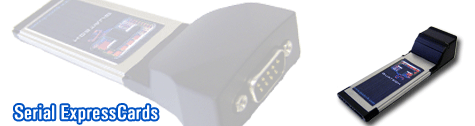
ExpressCard technology is emerging with faster speeds and better efficiency than the typical PCMCIA and PC Cards, connecting high-bandwidth peripherals to notebooks and other portables. The ExpressCard’s credit-card like format gives way to a smaller, faster and more desktop-friendly format. Gone are the days of laptops manufactured with PC Card slots and are swapped out with smaller, slimmer and thinner ExpressCard portals.
Features
New generation of I/O expansion for notebooks
Adds 1 or 2 high-speed PCIe-based serial ports
Adds 1 USB 2.0-based serial port
Supports PCI Express Base Specification Revision 1.1a
Adds 1 true parallel port
Installs in any ExpressCard slot
Built-in 1024-byte FIFOs buffers increase data transmit/receive speed
Baud rates up to 921.6Kbps (for SSPXP & DSPXP models)
Baud rates up to 115.2 Kbps with 16550-based serial units (for SSPX model)
Hot plugging and how swapping features
High speed ExpressCard with plug-n-play
Supports Windows XP/Vista operating systems
5 year warranty
Other Model Numbers
SSPXP-100
1 port performance PCIe-based RS-232 serial ExpressCard
SSPX-100
1 port USB 2.0-based RS-232 serial ExpressCard
DSPXP-100
2 port performance PCIe-based RS-232 serial ExpressCard
(2 LEFT IN STOCK AS OF October 2019)
SSPXP-200/300
1 port performance PCIe-based RS-422/485 serial ExpressCard
(1 LEFT IN STOCK AS OF AUGUST 2017)
DSPXP-200/300
2 port performance PCIe-based RS-422/485 serial ExpressCard
QSPXP-100
4 port performance PCIe based RS-232 serial ExpressCard
QSPXP-200/300
4 port performance PCIe based RS-422/485 serial ExpressCard
QSPXP-200/300
4 port performance PCIe based RS-422/485 serial ExpressCard